

Photo Credit: me and the sysop via Compfight cc
Podcasters love their stats. I've previously podcasted about RSS stats, but the even more mythical number is “monthly downloads” and I'll explain why.
WARNING: this post is long, contains simple math, and includes honest stats from my own podcasting. Do not attempt to read right after lunch.
I frequently see someone touting large monthly downloads for a podcast. In one particular case, someone even boasted going from 1,000 to 20,000 downloads per month.
That sounds impressive, doesn't it?
Misleading math of monthly downloads
“Monthly downloads” are actually highly inaccurate. They will always be cumulative and exponential with each new episode you publish and each new subscriber you gain.
Let's assume you start a new podcast and publish four episodes in the first month. You see a total of 1,000 downloads. But this is really 250 people who downloaded all four of your episodes.
250 new subscribers × 4 episodes = 1,000 downloads
Total: 1,000 downloads
The next month, you publish four more episodes and gain 100 new subscribers. Assuming those 100 new subscribers love you enough to download your past archive, your second month will have 1,800 downloads.
250 previous subscribers × 4 new episodes = 1,000 downloads
100 new subscribers × 4 new episodes = 400 downloads
100 new subscribers × 4 previous episodes = 400 downloadsTotal: 1,800 downloads
The third month, you publish four more episodes (total of twelve) and gain another 100 new subscribers. These new subscribers also go back and download your entire archive. Now your monthly downloads will be 2,600.
350 previous subscribers × 4 new episodes = 1,400 downloads
100 new subscribers × 4 new episodes = 400 downloads
100 new subscribers × 8 previous episodes = 800 downloadsTotal: 2,600 downloads
With each new episode you publish and each subscriber you gain, you exponentially increase your monthly downloads. A single new subscriber could result in 100 new downloads if they download your 100 episodes.
Monthly downloads are easy to boost
Want to take 1,000 downloads per month to 20,000? One way would be to produce more episodes without getting more subscribers.
250 subscribers × 80 new episodes = 20,000 downloads
No additional subscribers
No downloads of previous episodesTotal: 20,000 downloads
Although this seems ridiculous to produce 80 new episodes in a month, it would boost your monthly downloads, all without adding even one new subscriber—you still have the same 250.
But let's be more reasonable and mix it up. You producing more episodes, get more subscribers, and convince new subscribers to download previous episodes (you already have 50).
250 subscribers × 25 new episodes (one each weekday) = 6,250 downloads
200 new subscribers × 25 new episodes = 5,000 downloads
175 of the new subscribers × 50 previous episodes = 8,750 downloadsTotal: 20,000 downloads
The more episodes you have, the higher your monthly downloads will look. But monthly downloads are essentially meaningless.
My own real stats exposed
Let's use my complete Noodle.mx Network stats. In January, 2013, I had about 124,000 unique downloads (I could inflate this to 151,000 by including non-unique downloads).

Stats provided by Blubrry
That sounds impressive! But let's digest my own honest statistics.
By the end of January, 2013, I had about 450 episodes in my entire network's archive. 124,000 divided by 450 archived episodes works out to be about 275 downloads per episode for that month.
Ouch. No longer as impressive. But that whole calculation is based on the false premise of “monthly downloads.” And that monthly number goes up every month as we release about 20 episodes per month across Noodle.mx Network.
The truth-telling podcast statistic
Now let's consider a more accurate measurement. One of our episodes, from a month ago, now has about 7,500 unique downloads. That's not as impressive as “124,000 monthly downloads,” but this is truthful. It indicates that about 7,500 people downloaded that one episode.
(Yes, some people will download the same episode on multiple devices, which may increase the unique downloads, but this is a minority.)
Do I have 124,000 listeners? No. I had 7,500 for one particular episode. If that stat continues as the average, then I'll know roughly how big my audience is.
Don't lie to advertisers
The worst way to use this inflated “monthly downloads” number is when approaching advertisers. If an advertiser sponsored all of my podcasts, they would not get 124,000 impressions unless I placed their sponsorship in all 450 of my previous episodes and had my entire audience download everything all over again.
If my podcast averages 7,500 downloads per episode after a month, then I can give an advertiser a truthful number: 30,000 impressions.
4 episodes × 7,500 listeners (1 month after publication) = 30,000 total impressions
Episode longtail
I recommend one month as the general measurement for episode stats because most of your downloads will be in that first month (mostly weighted on the first week). Depending on how timeless your content is, you may continue receiving many downloads long after the first month.
For example, I looked at one of popular podcast episodes in Noodle.mx Network from 90 days ago, and here's how the downloads look over the last 90 days.
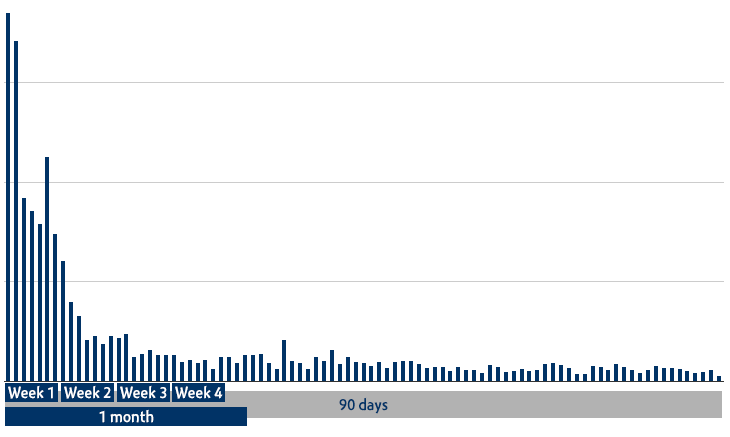
Stats provided by Blubrry
You can see the rapid falloff about a week after the episode was released. The continued downloads in the time since then are indication of the episode's longtail. I've heard that Grammar Girl‘s episode longtail is extremely impressive since she produces timeless, valuable content that is easy to consume (about 5 minutes in length).
Advanced stats would help us determine the source for those longtail downloads.
Now layer this example longtail with 450 similar episodes published a different times and you'll see where the 124,000 downloads come from and how inaccurate the big numbers actually are.
How to track downloads
For audio and video podcasters, I recommend only two services for tracking episode downloads:
LibSyn
LibSyn provides media hosting with basic stats starting at $5 per month. They can be your one-stop shop for podcast media hosting (audio or video), podcast website, syndication to iTunes and other podcast directories, and even iOS and Android apps. You can also use LibSyn as just your media host and power everything else from a separate podcast website using WordPress (my recommendation).
Downloads will be tracked no matter how you link to your media files hosted on LibSyn, because the tracking is built into the hosting.
Get your first month free with LibSyn if you use my affiliate code “noodle” when you sign up for any plan.
Blubrry
Blubrry provides free basic stats, premium stats for $5 per month (or $50 per year), and media hosting with premium stats for $12 per month. They are the easiest media host if you don't want to leave your WordPress interface. I also like their media stats system the best. You can integrate Blubrry's free or premium media stats on any media hosted anywhere (including LibSyn).
Blubrry works by adding an extra part to your media URL http://media.blubrry.com/[YOUR UNIQUE ID]/p/[PATH TO YOUR MEDIA FILE]. Downloads will be tracked anywhere you link to your media file with this full URL.
Blubrry's PowerPress podcasting plugin for WordPress will appropriately adjust your podcast media URLs on your website and in our RSS feed so they will be tracked.
Start telling the truth
Most of you aren't intentionally deceiving or inflating your numbers. But as podcasters, especially with other podcasters, we need to be honest and accurate.
I recommend that we drop the “monthly downloads” number in the same trash can as “RSS subscribers.”
Related Content


Wow. Great post. Thanks for the transparency!
Our RSS feed? 😛
hey, thanks for telling me about blubrrys tracking thing! I was using feedburner. What do you think of feedburner?
FeedBurner is unnecessary if you have a WordPress blog with PowerPress. The only way I would recommend FeedBurner is with its MyBrand feature so you’re having people subscribe to an feed URL you own, not FeedBurner’s.
Monthly downloads are only relevant if you want to communicate the number of total “exposures” to your content within that month. It isn’t very useful to advertisers unless they have been sponsoring the show since episode 1. The number of downloads within one month of release per episode would be a better indicator of subscribers. Or an average of the last 10 episode downloads.
Exactly. Like saying, “This is your potential monthly exposure.”
Great post Daniel. I’d suggest (as you’d expect me to) that all download numbers are a myth. They’re like print distribution numbers – and tell nothing of whether the show/content was actually listened to. So, if “monthly downloads” are a myth, so too are downloads. For the same reason.
Thanks, Michael! I look forward to when all podcatchers can employ the MediaGauge tracking.
We’ve pulled back from that initiative, so the hole remains in the market. It’s certainly no less true today than it ever was.
What’s funny is that everyone knows this – even the people selling ads, and no one is in a hurry to fix it. Wonder why? All it takes is for the media creators (podcasters) to demand real, accurate, and verifiable numbers from every outlet that plays their media. 🙂
If you put any content on YouTube, those stats are a bit more accurate on content. It always sucks to see a video that has 1000s of views, lose a majority of those viewers after the first few minutes.
Just remember though that 98% of podcast have burned all their downloads in the first 14 days the content has been online. “Very few shows” “less than 1%” have evergreen content. So for most shows their monthly uniques is a decent representation of the actual audience size.
At this moment—and I wanted to email Angelo about this—it seems that Blubrry doesn’t show me a “true uniques” number per month. By that, I mean that if John Smith downloads 10 different episodes of mine in a month, it seems that Blubrry reports those all 10 of those downloads in my total.
So if I released 4 episodes in a month, 1,000 unique downloads could mean 250 people downloaded all 4 episodes. Or are you saying that Blubrry’s system reports that 1,000 people downloaded up to 4,000 episodes?
Thank you for the providing the breakdowns Daniel. I had no idea that those stats were cumulative. I honestly I don’t think we can really know the true reach of our audience – in terms of the number of actual listeners.
Great post Daniel. Not only do you do yourself a disservice by inflating your numbers, but you potentially hurt the podcasting community as the sponsor may think, “Podcast doesn’t work for us” because their expectations were set on false numbers.
Great point! “You said you have 20,000 downloads per month. Why did only 20 people take action?”
Excellent article, Daniel! My own little podcast has just started out, and I’m only beginning to discover how the numbers work… but you’ve provided some very useful info here. Many thanks!
Top notch post Daniel! Thanks for the insight, it’s clear why you are an award-winner in the podcasting field.
Yeah, I constantly hear “the competition” talk about thousands upon thousands of downloads, but they’re always complaining about not getting the support you’d expect from such a huge audience. It’s good to be honest with yourself, not just the community around you.
I wanted to see whether my audience was growing, and also to make “apples to apples” comparisons between episodes. The stat that I came up with for this is a cumulative age-based download count. A sample plot can be seen at http://therecoveryshow.com/wp-content/uploads/2013/04/statsplot.png . Each curve represents one of the most recent 10 episodes. The start of each curve is the day it was released, and the horizontal axis is “days since release”. I can easily see that after 20 days episode 14 (sky blue) had almost 200 more downloads than episode 11 (olive) did 20 days after its release. I can see that, in general, newer episodes have faster uptake than older ones did, which says to me that my audience is growing. I can see that older episodes continue to have new downloads (the long tail effect). And I can see that certain topics are more (or less) popular than others.
It wasn’t trivial to create this. It’s based on Blubrry’s “day to day trend” numbers for each episode. I wrote a script using the curl command to download the 90 day trend numbers for each episode, and then a small R program produces the graph. Because it’s based on the trend numbers, which are not reduced to “unique” downloads, the numbers themselves are inflated by 20%-30%. But the trends and relative popularity numbers are pretty clear.
Three of the curves on the graph show a sharp uptick near the end. That’s an artifact of an incident where one client downloaded each episode about 1500 times in one day (and about 50-100 times in the two preceding days). The actual curves go out of the top of the graph, and are cut off at the previous data point.
I find this presentation helpful. What do you think?
That’s fantastic! I love the visualization. Any plans to make this publicly available? Or maybe you could offer the code to Blubrry.
This is super helpful! I just started a podcast three weeks ago and was confused about how to determine the size of my audience for potential advertisers. Monthly downloads look so impressive, but the numbers on the individual episodes really are much more meaningful.
A way advertisers may like to hear it is if you can calculate a minimum monthly impressions. This means something more to them.
So if you release 4 episodes in a month and each episode will average 100 downloads within two weeks, then a one-month sponsorship of your episodes would result in 400 impressions. Release two episodes per week with these same listeners and your impressions double to 800.
That’s a great way to frame it. And good to know that impressions don’t necessarily have to be an entirely different group of people every time–I’d been confused about that too. Thanks so much!
A single impression actually isn’t worth much. It takes at least three impressions … to actually leave an impression. 🙂
—
Sent from Mailbox for iPad
Great post, thanks Daniel.
Do you know of a way to calculate podcast subscribers or are we only able to measure downloads?
“Subscriber” is an ambiguous term. Would you consider someone a “subscriber” if they faithfully visit your site every week and listen to your episodes through your site?
I think the better term is “consistent audience.” You can get that by looking at your download numbers per episode after four weeks.
If you really want to know about “subscribers,” you could look at the user agents/clients to see how many are coming from podcast apps and then assume those are subscribers.
Awesome read! Thanks for the info Daniel.
Good stuff. Thanks for the tips
[…] audience pulling down 2 million downloads a month (granted, downloads is a somewhat murky metric for gauging listeners) may not seem like a lot in comparison to a radio audience. (NPR’s All […]
Daniel,
This post is very enlightening. If I were to sum it up, I would say, “Do not pay attention to monthly downloads; do pay attention to recent average unique downloads per episode.” Is this an accurate summary?
On a related issue, is there any way of learning number of subscribers (in iTunes, Stitcher, etc.)? Your last sentence seems to suggest that knowing subscribers is not helpful, but maybe you were only referring to RSS subscriptions and not directory subscriptions like iTunes, Stitcher, etc.. However, it seems subscriber counts from the directories would be a good metric to view in combination with the one you are suggesting. For example, if your recent average unique downloads per episode were 7,500 (as you use in your example in the post), then whether your total subscriptions from directories (e.g iTunes, Stitcher, etc.) was 1,000 or 5,000 would tell you something valuable, wouldn’t it?
Hi, Mike!
Yes, that’s a decent summary.
It seems you’re actually interested in platform numbers instead of “subscriber” numbers. You can use Blubrry’s premium stats or LibSyn’s stats to see information about how people are downloading your episodes. This is pulled from “user agents” and you can see the breakdown of Stitcher, iTunes, mobile devices, and more.
I never thought about having to insert an ad into every single previous episode AND have everyone re-download those episodes in order to actually reach everyone that you claim to be reaching with your monthly download stats.
Very well thought out post. Thanks Daniel.
Thanks, Derek! There are a few emerging technologies that can do that. I’m reviewing one right now. 🙂
Thank you! Thank you! Thank you! Amazing and useful post!
Good post.. Insightful and helpful. Here’s what still doesn’t add up. If monthly downloads are basically cumulative, why do stats go down some months? Why does the download stat stay flat some months, even when new shows are added? When no new shows are added and we move to a new month and see a drop in the total download stat, what are we actually seeing? Based on your explanation I would expect stats to only go in one direction– Up. Can you explain this behavior with the stats?
Monthly downloads are usually cumulative. But they could stay level off if your new-subscription growth slows, or if you lose subscribers while gaining others.
But you’re also asking this during summer in the northern hemisphere. Summertime commonly sees download lulls in certain industries—especially related to TV shows.
Cumulative may be the wrong word. It’s not including previous downloads. It is including current month downloads of previous episodes though.
Very helpful. Thanks!
Do successful podcasters even still make money off these false numbers of downloads?
“Successful” is up for interpretation, if they’re using false numbers.
Do they still make money? Probably not from the same sponsor who was expecting more business from the podcaster’s inflated numbers.
Awesome article, and great to see you busting wide open the myth on the thousands of downloads per episodes, that the multitude of podcasters tend to use. Your honesty is very brave, and I’m also considering having an open door policy on my stats going forward. Libsyn tells me I have almost 400 unique downloads on my first episode (https://traffic.libsyn.com/chaosandtheory/CAT_Ep1.mp3) after only four days and I’m only using my Twitter and Facebook to promote, and not listed on iTunes or any other podcast network yet. So here’s hoping. Again, great move on the authenticity drive. I imagine your advertisers respect you for it.
Thanks!
If you’re posting direct links to your media files on Facebook and Twitter, then most of the downloads are probably accidental and not true listens. You really need to get into iTunes and start looking at your user agent stats to see how many are using iTunes to listen.
yes that’s what I am interested in…not sure how to go about it but I guess i’ll figure it out sooner or later.
My Podcast has been up nearly a week. I’ve been seeing on Libsyn total downloads. I tried Bluebrry, but their service’ userability is terrible. I am interested in knowing how many subscribers I have, or is my thinking wrong?
Look at your download numbers for a single episode and that will give you an idea. To be more accurate, look at the nerdy “user agent” information and pay attention to iTunes and AppleCoreMedia. Blubrry stats are actually easier to understand because you can easily see “podcatchers” and other simple-English labels.
Give each episode at least a week, but a month is better.
So… let’s say that you take a break. Let’s say a year or more, with no new episodes. You stop paying your monthly subscription. What happens to your podcasts? What *can* you do in a situation like this to keep them accessible?
Downgrade your media hosting plan to the smallest plan during those times. They’ll keep your media online and your stats still counting.
[…] before I get into it, I want to give due credit to Daniel J. Lewis, for his awesome article on tracking podcast downloads. It helped me out a lot in the early stages, […]
[…] Audacity to Podcast – 7,500 downloads per episode according to this post. This is for a popular show which has been running for […]
This post is helpful. Advertisers need to be savvy when they start using an advertising channel as well. As a marketing professional myself, I have to ask the questions that really matter. IE. “How many impressions will my ad get and where are you getting that number?” If they can’t break it down to be backed up with 3rd party tracking, what is the point of talking further. That is just like buying a billboard spot in a forest. You got to vet these things out.
Also I want to commend Daniel for writing this post. It was to podcasters, which I am also … Having talked to many podcasters, I know that most of them don’t know that they are “lying”… So this post serves as a great piece of awareness, and I appreciate your writing it and will surely pass it along when relevant.
[…] “Monthly downloads” are actually highly inaccurate. They will always be cumulative and exponential with each new episode you publish and each new subscriber you gain – Daniel J. Lewis – The Audacity to Podcast […]
Oh don’t burst my bubble! 🙂
[…] “Monthly downloads” are actually highly inaccurate. They will always be cumulative and exponential with each new episode you publish and each new subscriber you gain – Daniel J. Lewis – The Audacity to Podcast […]
What about listening or viewing time of the podcast? How does this figure in? Do advertisers ask about that?
Thank you for this! Is there any way to know who listened to part or whole podcast?
Hi, Tom!
Listen completion data is best tracked by the app or player itself, and so you would get those stats from those providers. For example, Apple Podcasts provides exactly that kind of data in PodcastsConnect.com. Stitcher offers similar data. And some embeddable players, like from SimpleCast, can show you website playback completion data.
Good Article, and great insight. I would say though as a person who podcast regularly, and has no desire to monetize, downloads per month work well for me. I run a Christian Podcast and don’t really care if I have 50 to 1,000 listeners. What makes me continue to do it is knowing that people actually listen. If its the same 50 people each month that’s great. Growth is what we all want to see, but the reasons behind why we want the growth differs greatly depending on the purpose of your content. I like to keep up with my monthly downloads as an indication of people listening. Again, I have no desire to make money from my podcast, so detailed information really does me no good, but your math seems to work out. Thanks again for an excellent article.
[…] can read this piece by Daniel Lewis, an award-winning podcaster, about monthly downloads – podcasting myth where he has already explained beautifully with proper examples as to why this is the wrong metric […]